
*This information was originally published as part of an abstract for Kidney Week 2025*
Understanding C3G and IC-MPGN and the Unmet Patient Need
Complement 3 glomerulopathy (C3G) and primary immune complex membranoproliferative glomerulonephritis (IC-MPGN) are rare kidney diseases characterized by dysregulation of the alternative complement pathway. Historically, treatment has been limited to non-specific immunosuppressive approaches, but recent FDA approvals of the complement inhibitors iptacopan and pegcetacoplan mark a major shift toward targeted therapy.
As these novel agents enter practice, clinicians face the challenge of integrating new diagnostic criteria, understanding complement-mediated mechanisms, and applying evidence-based use of complement inhibitors (CIs). Persistent knowledge gaps may delay appropriate diagnosis and treatment, underscoring the need for continuing education to prepare nephrologists and advanced practitioners for these emerging standards of care.
The Medlive Approach
To address these evolving educational needs, Medlive partnered with the National Organization for Rare Disorders (NORD) and Kidney Disease: Improving Global Outcomes (KDIGO) to develop a continuing medical education (CME) program focused on improving clinical readiness for C3G and IC-MPGN management.
The program, launched in March 2025, included two 60-minute enduring online CME sessions supported by targeted micro-learning videos distributed to NPI-verified nephrologists. Educational content combined expert commentary with case-based learning to improve understanding of complement-driven pathology, diagnostic approaches, and therapeutic advances.
Session 1, ‘Parsing the Diagnostic Process of Glomerular Diseases with an MPGN Pattern of Injury’, focused on diagnostic differentiation between C3G and IC-MPGN through patient history and immunofluorescence staining, while Session 2, ‘Preparing for a Change in Standard of Care for C3G and IC-MPGN’, reviewed emerging data on complement inhibitors and evolving treatment guidelines. Sessions are available on-demand, here.
Key Findings
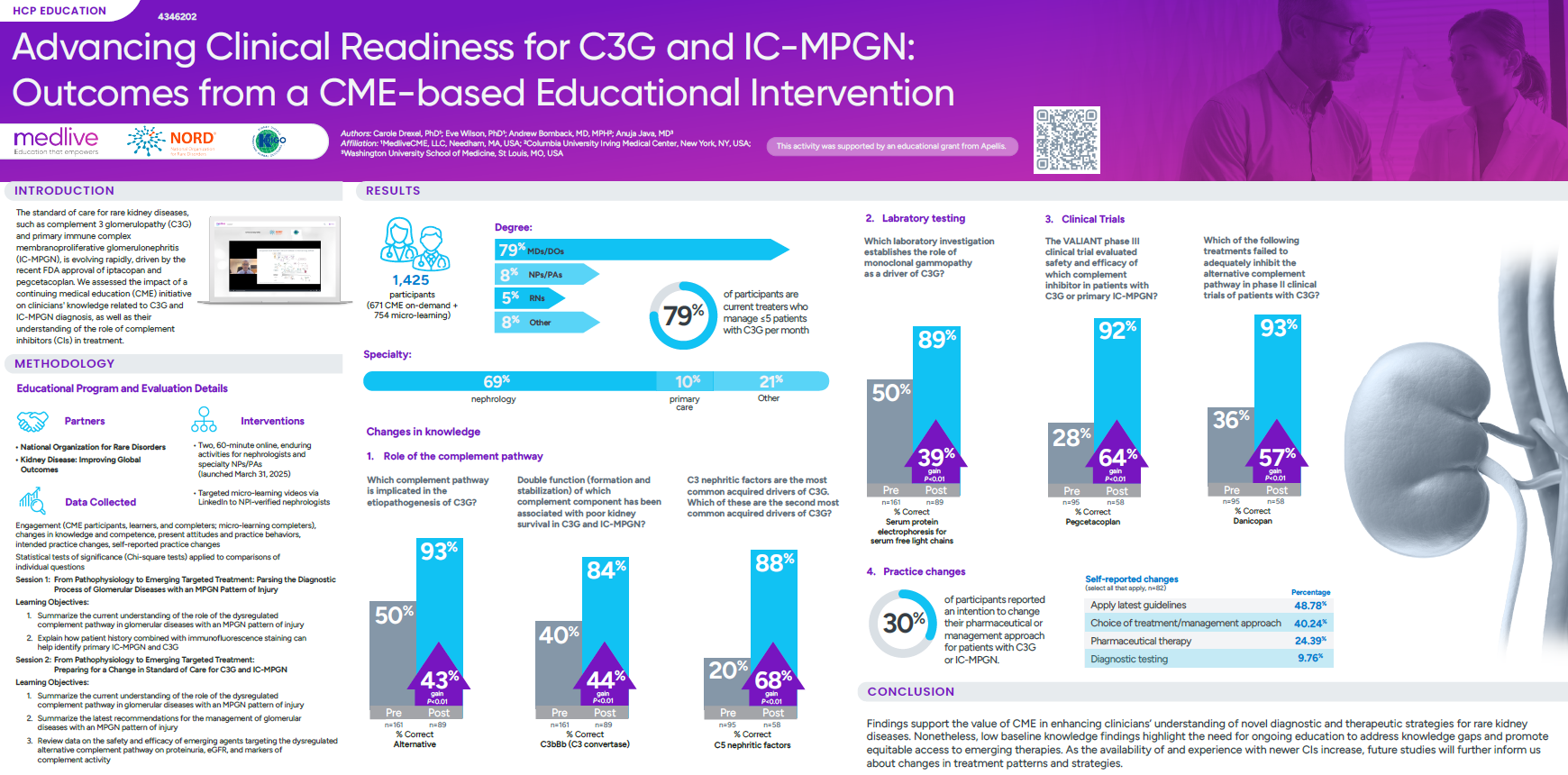
- Audience engagement: A total of 1,425 participants engaged in the education, including nephrologists (69%), advanced practice providers (8%), and primary care clinicians (10%). Seventy-nine percent reported actively managing patients with C3G.
- Clinician learning gains: Knowledge of complement pathway involvement improved from 50% to 93%, and understanding of the role of C3bBb (C3 convertase) in kidney survival increased from 40% to 84% (p<0.01). Recognition of C5 nephritic factors as secondary drivers of C3G rose from 20% to 88%, representing a 68% improvement. Awareness of key diagnostic tests, such as serum protein electrophoresis for identifying monoclonal gammopathy, improved by 39%, while knowledge of clinical trial evidence rose substantially—64% for pegcetacoplan and 57% for danicopan (p<0.01).
- Practice impact: Thirty percent of participants reported an intention to change clinical management, with nearly half planning to apply the latest guidelines (49%) and 40% adjusting treatment selection or pharmaceutical therapy for patients with C3G or IC-MPGN.
Conclusion – Collaborating for Improved Patient Outcomes
This CME initiative significantly improved clinicians’ understanding of the complement pathway and emerging therapeutic strategies for C3G and IC-MPGN. While outcomes demonstrated substantial knowledge gains and reported intent to change practice, low baseline awareness highlighted the need for continued education to ensure equitable access to novel complement inhibitors.
As the field advances, sustained learning efforts will be essential to align diagnostic precision, therapeutic confidence, and patient access—supporting better outcomes for individuals living with these rare complement-mediated kidney diseases.
To learn more about partnering with Medlive to develop impactful CME programs, reach out via our Contact Us page.
This initiative was supported by an independent medical educational grant from Apellis.