
*This information was originally published as part of an abstract for the ACG 2025*
Understanding Eosinophilic Esophagitis (EoE) in Young Children and the Unmet Patient Need
Eosinophilic esophagitis (EoE) is a chronic, immune-mediated disease that can cause feeding difficulties, growth impairment, and significant quality-of-life challenges for children and their families. Recent advances, including the expanded FDA approval of a biologic therapy for children under 11 years of age, have transformed the treatment landscape, reducing dependence on restrictive elimination diets and off-label therapies.
Despite this progress, gaps remain in clinical awareness and patient readiness to adopt new treatments. Many families continue to face barriers related to cost, access, and uncertainty about biologic use in young children. Strengthening both clinician and caregiver understanding of therapeutic options and enhancing communication around shared decision-making are essential to improving pediatric EoE management.
The Medlive Approach
To address these gaps, Medlive developed two complementary education programs, one for clinicians and one for patients and caregivers, in partnership with the Asthma and Allergy Foundation of America (AAFA), Campaign Urging Research for Eosinophilic Disorders (CURED), Depression and Bipolar Support Alliance (DBSA), and the National Association of Pediatric Nurse Practitioners (NAPNAP).
The patient and caregiver program, EoE Care for the Littles: New Treatments and Tips from Caregivers Like You!, launched in October 2024 as a live and enduring series hosted in partnership with advocacy organizations and featured caregiver stories, practical advice, and a focus on shared decision-making.
The clinician-focused CME activity, EoE in the Littles: Early Diagnosis and New Treatment Options, was launched in November 2024 as a 60-minute live-online and enduring program which incorporated feedback from patient advocacy partners and insights from the learners who participated in the caregiver education, supported by micro-learning videos distributed via LinkedIn to NPI-verified gastroenterologists.
Both activities included a dedicated segment on “Shared Decision-making and Transition of Care” to promote alignment between clinicians, caregivers, and pediatric patients.
Key Findings
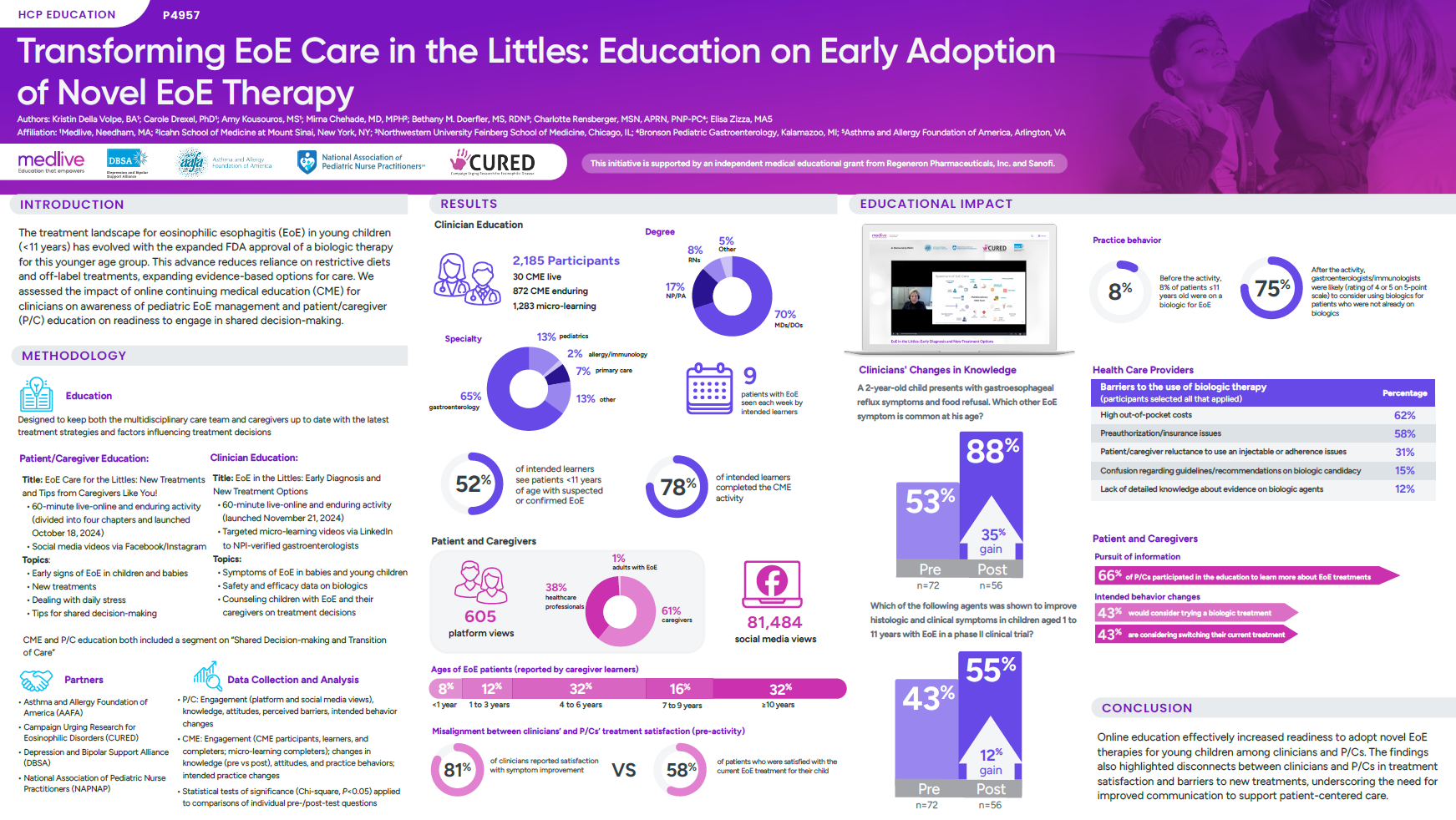
- Improved clinician knowledge: Following education, correct responses increased from 53% to 88% for recognition of EoE symptoms in young children and from 43% to 55% for knowledge of biologic therapy efficacy (p<0.05).
- Readiness to adopt biologic therapy: After education, 75% of gastroenterologists and immunologists reported they were likely to consider biologics for pediatric patients not already receiving them—up from 8% prior to the activity.
- Misalignment between clinician and caregivers’ satisfaction with current treatment options: 81% of clinicians reported satisfaction with symptom improvement in their pediatric EoE patients, while only 58% of caregivers were satisfied with their child’s current treatment
- Patient and caregiver engagement: The caregiver program achieved 81,484 social media views and 605 platform views. Sixty-six percent of caregivers participated to learn more about available treatments, and 43% indicated they would consider trying or switching to a biologic therapy.
- Clinician engagement: The clinician program saw 2,185 participants. Sixty-five percent of the participants were from the gastroenterology specialty. 52% of intended learners see patients under 11 years of age with suspected or confirmed EoE.
Conclusion – Collaborating for Improved Patient Outcomes
Online education for both clinicians and caregivers effectively increased readiness to adopt novel EoE therapies for young children. Findings highlighted differences in treatment satisfaction and perceived barriers between clinicians and caregivers, reinforcing the importance of improved communication to support shared decision-making and long-term disease management.
By engaging the full care network through aligned educational design, Medlive’s programs fostered greater awareness, confidence, and collaboration—helping ensure that children with EoE and their families can benefit from the expanding range of safe and effective treatment options.
To learn more about partnering with Medlive to develop impactful CME programs, reach out via our Contact Us page.
This initiative was supported by an independent medical educational grant from Regeneron Pharmaceuticals, Inc. and Sanofi.