
*This information was originally published as part of an abstract for the 2026 Alliance Annual Conference*
Cumulative Outcomes Reveal Broader Trends Across Six Therapeutic Areas: Asthma, Atopic Dermatitis, Food Allergies, Eosinophilic Esophagitis (EoE), Nasal Polyps, and Urticaria
As digital education continues to expand across healthcare, it is increasingly important to understand educational impact beyond individual activities. While single-program outcomes provide valuable insight, they do not always reflect the broader, cumulative effect of education delivered across multiple programs, audiences, and therapeutic areas.
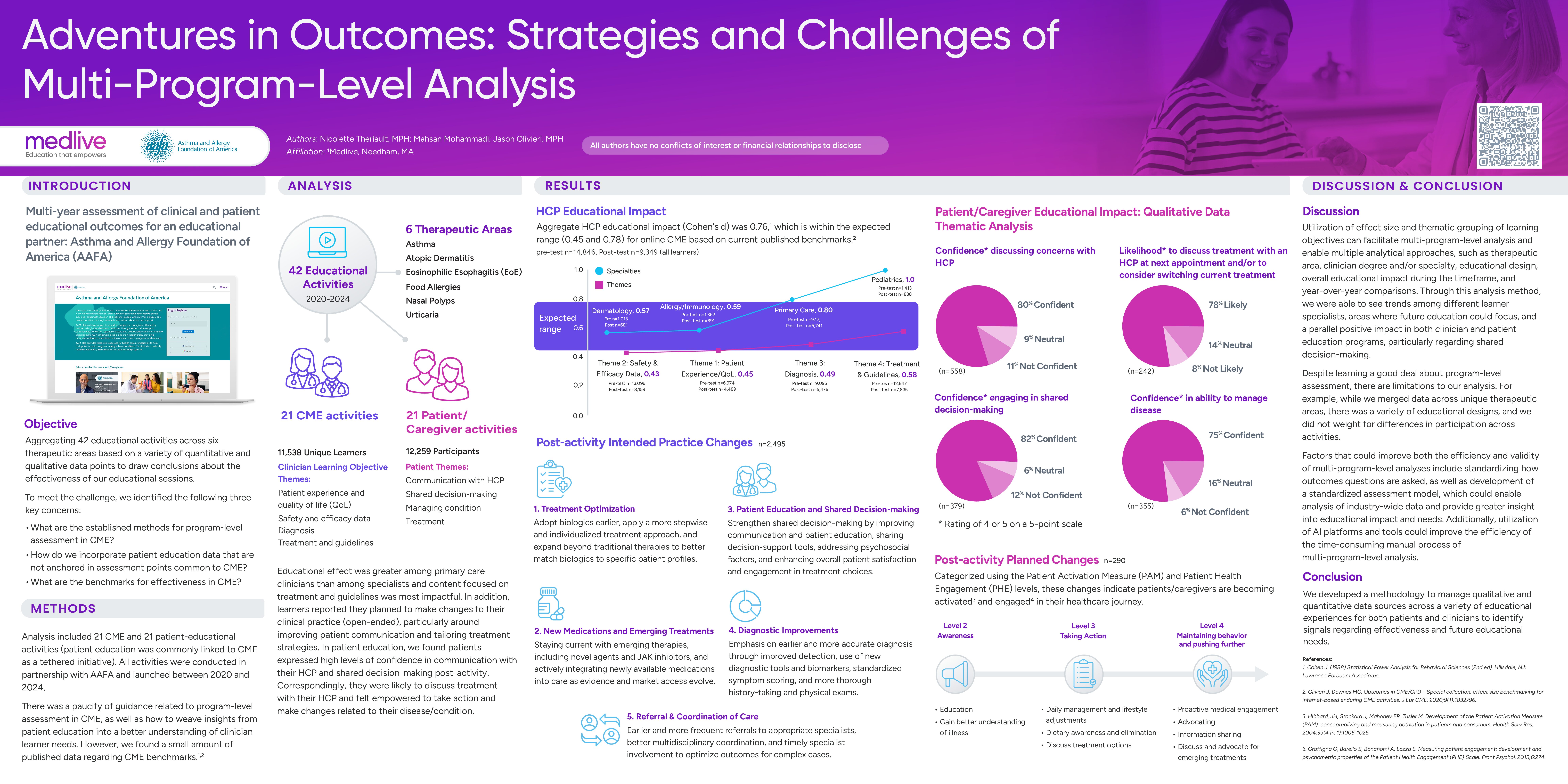
At the 2026 Alliance Annual Conference, Medlive will present an outcomes poster focused on the analysis of aggregate data from 42 clinician and patient educational activities spanning six therapeutic areas over a 4-year period to evaluate educational effectiveness. By examining both quantitative and qualitative data from clinician and patient education, the analysis offers a comprehensive look at how Medlive’s education performs across multiple activities and over time.
The Medlive Approach
To develop a broader, summarized view of educational impact, Medlive evaluated a portfolio of education programs delivered in partnership with the Asthma and Allergy Foundation of America (AAFA) and designed for clinicians, patients, and caregivers, including tethered clinician and patient education. The analysis, titled “Adventures in Outcomes: Strategies and Challenges of Multi-Program-Level Analysis,” included 42 educational activities (21 CME programs and 21 patient and caregiver initiatives) launched between 2020 and 2024 across six therapeutic areas: asthma, atopic dermatitis, food allergies, EoE, nasal polyps, and urticaria.
Faculty-led CME programs focused on disease management, treatment strategies, and guideline-based care, while patient education emphasized confidence, communication, and shared decision-making.
The patient and caregiver education initiatives were delivered as digital, video-first programs focused on building disease understanding, awareness of treatment options, improving communication with healthcare providers, and supporting shared decision-making. These activities emphasized practical guidance, confidence-building, and patient activation, and were often designed as tethered initiatives aligned with clinician education.
The clinician-focused CME activities were delivered as live-online and enduring digital, video-first programs addressing diagnosis, treatment strategies, and guideline-based, patient-centered care. Content was designed to improve understanding and support practical application into clinical practice and was informed by key patient themes identified through parallel patient education activities.
Together, these clinician and patient programs enabled Medlive to aggregate quantitative and qualitative outcomes data across multiple educational designs and therapeutic areas, providing a comprehensive view of educational effectiveness and informing future education strategy.
Program Goals
The primary goal of this analysis was to determine whether meaningful conclusions could be drawn from aggregated qualitative and quantitative data across programs to better understand Medlive’s educational impact and inform future program development.
To meet this challenge, we identified the following three key concerns:
- What are the established methods for program-level assessment in CME?
- How do we incorporate patient education data that are not anchored in assessment points common to CME?
- What are the benchmarks for effectiveness in CME?
Data Analysis
Medlive developed a methodology to manage and merge outcomes data across diverse educational designs, learner types, and therapeutic areas. Quantitative outcomes were analyzed using effect size (Cohen’s d) based on CME benchmarks, while qualitative data were categorized thematically to identify patterns in learning, confidence, and intended behavior change.1,2 Patient and caregiver qualitative data were analyzed using the Patient Health Engagement Scale and the Patient Activation Measure.3,4
Key Findings
- Education reached clinicians and patients at scale: The analysis included 42 educational programs delivered between 2020 and 2024, reaching 11,538 unique clinicians and 12,259 patients and caregivers across six immunologic conditions.
- Primary care clinicians showed the biggest gains: Educational effect was strongest among primary care clinicians and pediatricians, with learning improvements exceeding those seen in specialty audiences such as dermatology and allergy/immunology.
- Treatment-focused education had the greatest impact: Programs centered on treatment approaches and clinical guidelines led to the most meaningful improvements in clinician learning compared with content focused on diagnosis, efficacy and safety data, or patient quality of life.
- Clinicians planned to change how they practice: After participating in education, clinicians reported plans to improve patient communication, better individualize treatment strategies, and more confidently integrate new and emerging therapies into care.
- Patients felt more confident and ready to act: Following education, 80–82% of patients and caregivers felt confident discussing concerns and making decisions with their healthcare provider, and 78% said they were likely to talk about treatment options or consider a change at their next appointment.
Conclusion
Aggregating outcomes data across 42 educational activities provided a comprehensive view of Medlive’s educational impact across six therapeutic areas. This multi-program-level analysis demonstrated meaningful improvements in clinician learning and patient confidence, particularly in areas related to treatment strategies, guideline-based care, communication, and shared decision-making.
At the same time, the analysis highlighted opportunities for continued education to further address residual gaps, refine content focus by learner specialty, and strengthen alignment between clinician and patient education. These insights reinforce the value of program-level outcomes analysis in guiding future educational design and ensuring education continues to meet the evolving needs of clinicians, patients, and caregivers.
To learn more about partnering with Medlive to develop impactful CME programs, reach out via our Contact Us page.
References
- Cohen J. (1988) Statistical power analysis for behavioral sciences (2nd ed). Hillsdale, NJ: Lawrence Erlbaum Associates.
- Olivieri J, Downes MC. Outcomes in CME/CPD – Special Collection: Effect Size Benchmarking for Internet-based Enduring CME Activities. J Eur CME 2020 Oct 9;9(1):1832796. doi: 10.1080/21614083.2020.1832796
- Hibbard, J. H., Stockard, J., Mahoney, E. R., and Tusler, M. (2004). Development of the Patient Activation Measure (PAM): conceptualizing and measuring activation in patients and consumers. Health Serv. Res. 39, 1005–1026. doi: 10.1111/j.1475-6773.2004.00269.x
- Graffigna G, Barello S, Bonanomi A and Lozza E (2015) Measuring patient engagement: development and psychometric properties of the Patient Health Engagement (PHE) Scale. Front. Psychol. 6:274. doi: 10.3389/fpsyg.2015.00274